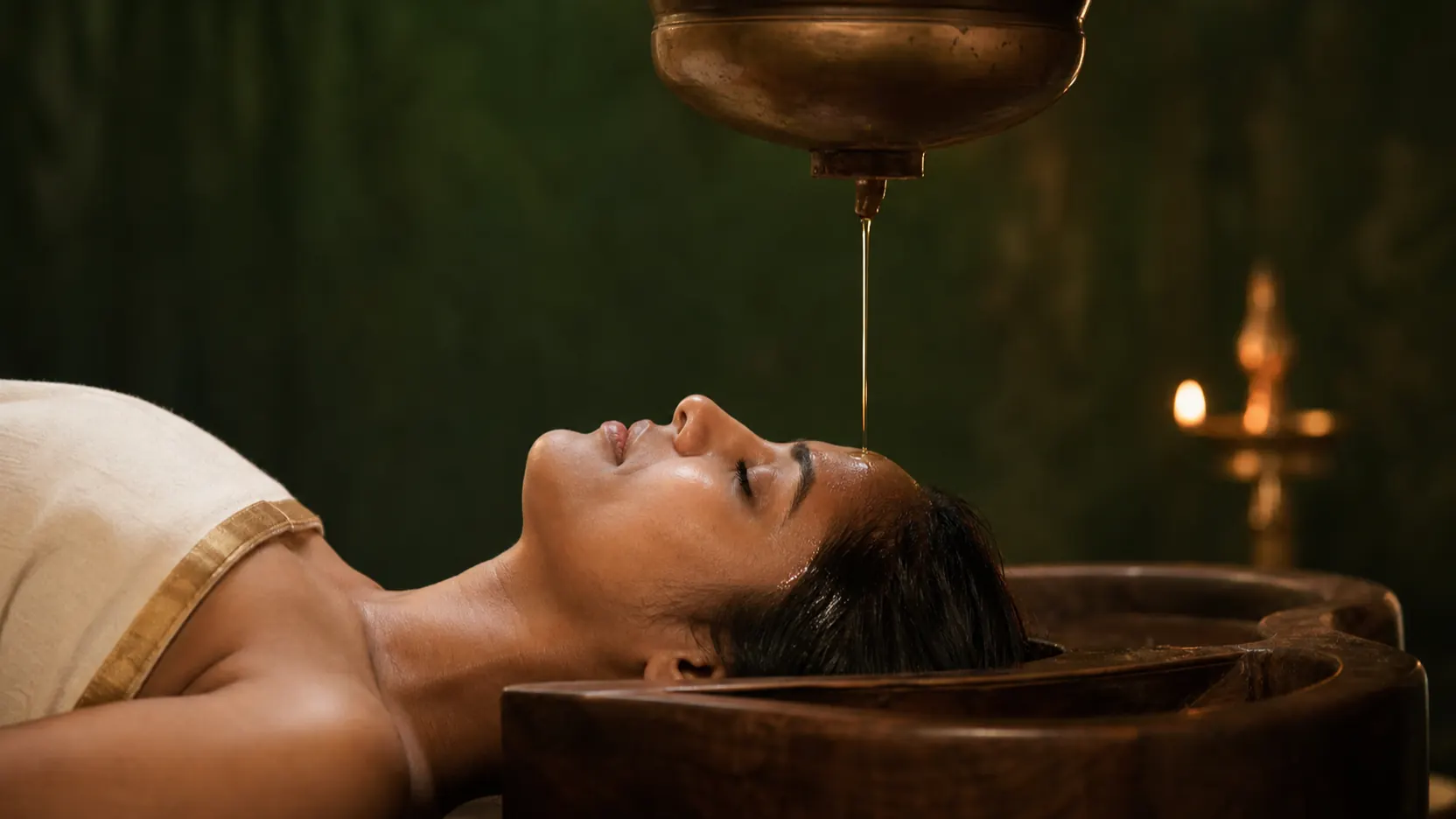
Classical Ayurveda gives the mind its own medicine: an agitated, fearful, sleepless state reads as vata disturbing the mind's steadiness, treated by stilling the system — the continuous warm stream of shirodhara, the Kerala head therapies, oil massage, and the medhya rasayana herbs the texts class as nourishment for the mind — inside a daily rhythm designed to be the opposite of the life that produced the state. Severe conditions belong with psychiatric care, and honest physicians say so.
How classical Ayurveda understands it
The texts treat mental steadiness as a clinical subject: the mind (manas) has qualities, they can be disturbed, and the disturbed picture most people bring — racing thought, fearfulness, broken sleep, exhaustion that won't rest — reads classically as vata unseated: too much movement in the system, too little ground.
The classical answer is not analysis but stilling: warmth, oil, rhythm, sameness. Kerala's contribution is the therapy set built exactly for this — shirodhara above all, the oscillating warm stream on the forehead that the tradition holds as its deepest calming instrument — plus the head therapies and the medhya (mind-nourishing) herb class: brahmi, shankhapushpi, ashwagandha.
The classical toolkit
The calming repertoire is Kerala's signature — these are its classical instruments.
| Therapy | What it is | Classical role |
|---|---|---|
| Shirodhara | A continuous warm stream — oil, milk or buttermilk — oscillating on the forehead, ~30–45 minutes | The tradition's deepest calming instrument; takradhara (buttermilk) is the classical insomnia variant |
| Abhyanga + swedana | Full-body warm oil massage and gentle steam, daily | The vata-settling base of the whole programme |
| Shirovasti / thalapothichil | Warm oil held on the crown; the Kerala medicated head-pack | The head-directed therapies for sleep and agitation |
| Nasya | Gentle herbal administration through the nose | The texts' route to the head — used in the calming sequence |
| Medhya rasayana | Brahmi, shankhapushpi, mandukaparni, ashwagandha | The classical mind-nourishing herb class, physician-dosed |
| Dinacharya + quiet | Fixed gentle rhythm, early sleep, no screens, no schedule pressure | The programme's frame is itself the medicine |
Internal medicines — decoctions, classical formulations — are prescribed by the physician after assessment, never off a menu. If you take psychiatric medication, it continues — the physician coordinates, and severe or crisis states belong with psychiatric care first.
Burnt out rather than unwell? That's exactly this programme's territory — ask.
Ask about a calming programme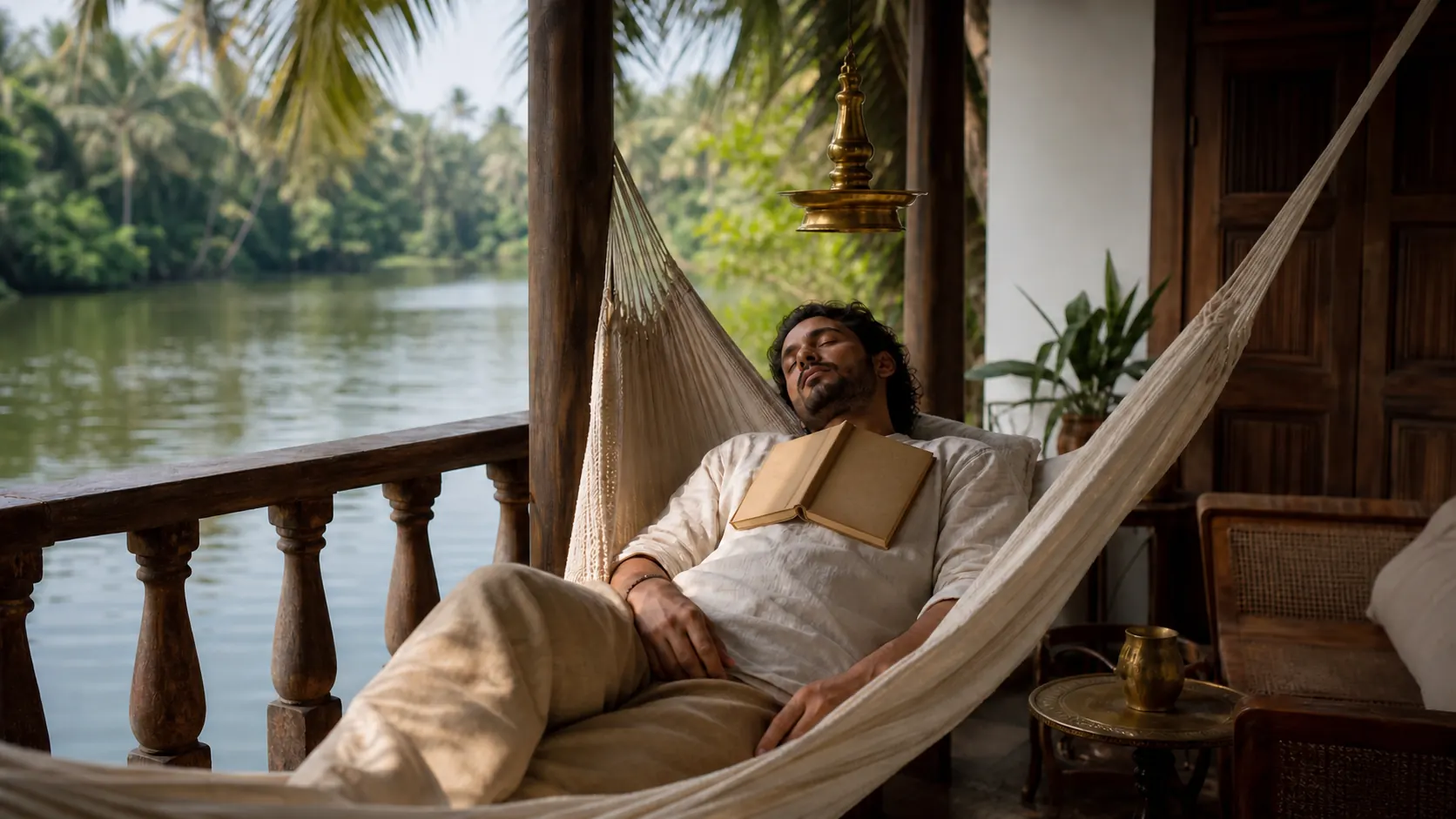
The setting is the therapy
A fortnight with nothing pulling at you
The calming programme is where setting genuinely joins the medicine: quiet rooms, water and palms, no schedule beyond treatment and meals, phones politely discouraged. Days are deliberately same — therapy mid-morning, warm food at fixed hours, rest, early sleep — because sameness is what an unseated vata needs.
Guests consistently report sleep returning first, then the background hum settling. The daily rhythm in full.
How long, and what it costs
Calming programmes work at 7–14 nights — the shortest window in which sleep and rhythm genuinely reset — with 14–21 nights prescribed where exhaustion runs deep.
Kerala rates, verified July 2026, all-inclusive: 14 nights runs
₹67,000–
What an honest physician will tell you
That a retreat is not a substitute for psychiatric care — severe anxiety, depression or crisis states need a psychiatrist first, and a genuine physician screens for exactly that and refers without hesitation. Psychiatric medication continues under the doctor who prescribed it. What the programme honestly offers is a physician-led stilling of the system — sleep, rhythm, rest, the classical calming repertoire — and that offer is real.
What Ayurbook does
The right physician for this, matched to you
We've verified 258 Ayurveda centres across Kerala — the state's classification and NABH's clinical register, both checked. Tell us your situation, dates and budget; we match you to a centre whose physicians actually work with stress and anxiety care, with the price in writing before you pay.
Common questions
I'm not ill — just burnt out and sleeping badly. Is this for me?
This is precisely the programme's home territory: the working-life vata picture — racing, wired, tired, sleeping thin. A 7–14 night stilling programme is built for exactly that state, and it is the classical use, not an adaptation.
What does shirodhara actually feel like?
A warm, steady stream moving slowly across the forehead while you lie still — most guests describe dropping into a state between waking and sleep within minutes. Sessions run 30–45 minutes inside a sequence of massage and rest.
Will they take my phone away?
Nobody confiscates anything — but the programme works best with screens set aside, physicians say so plainly, and the schedule is built so there's nothing to check. Most guests find day three is when the reflex fades.
I take medication for anxiety. Can I still come?
Yes, with honesty at screening: the medication continues under your prescribing doctor, the physician coordinates, and severe or unstable states are referred to psychiatric care first — a genuine centre is direct about that line.
What lasts after the fortnight?
Sleep is the most-reported keeper, along with the rhythm — fixed meals, early nights — and the physician's take-home practices. The programme is designed as a reset you maintain, with follow-up available.
What will it cost?
The verified tier structure: 7 nights ≈₹33,000–88,000 · 14 nights ₹67,000–3.4 lakh, all-inclusive by tier. Full breakdown — exact price in writing before you pay.