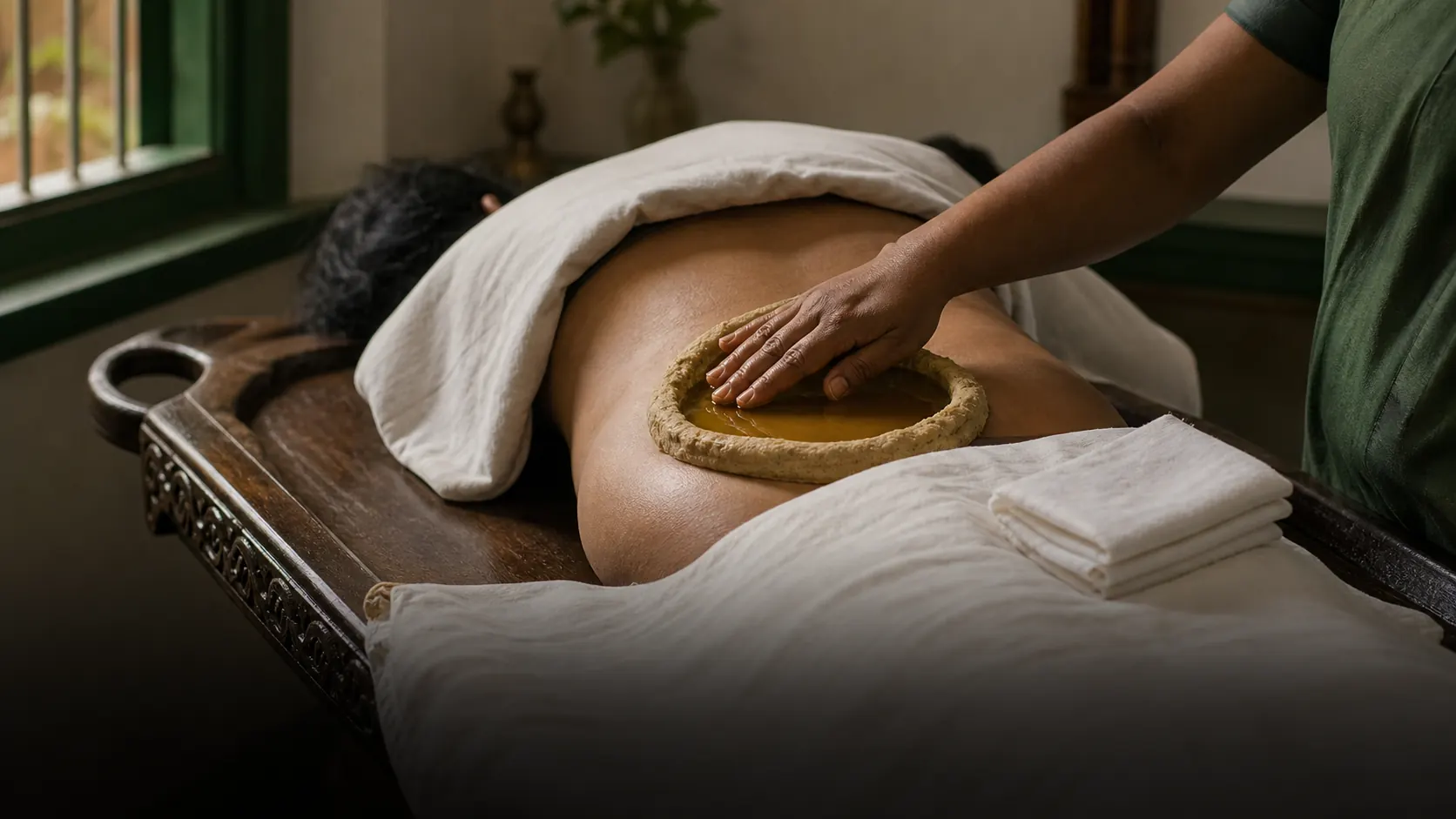
The classical texts read most back trouble as vata in the kati (low back): kati shoola for back pain, and gridhrasi — “the vulture's grip” — for pain that seizes and travels down the leg, the picture modern medicine calls sciatica. The classical response: sustained warmth and oil on the site, boluses to the muscles along the spine, and vasti — the deep therapy the texts assign to vata itself — with daily physician review.
How classical Ayurveda understands it
Vata governs movement, and the texts make the low back and pelvis its home ground. When it is aggravated — by strain, long sitting, age, or depletion — the back announces it: kati shoola (low-back pain), kati graha (the seized, rigid back), and gridhrasi, named for the vulture because of how the pain grips and travels down the leg.
The classical logic of treatment is direct: vata is dry, cold and mobile, so the medicine is unctuous, warm and stabilising — oil held on the site, heat through boluses, and the vasti series that the texts rank as the deepest answer to vata.
The classical toolkit
The back-care repertoire is one of Kerala's most practised — these are its classical instruments.
| Therapy | What it is | Classical role |
|---|---|---|
| Kati vasti | A dough ring on the low back holding a pool of warm medicated oil, refreshed as it cools | Sustained local oleation exactly where vata has seized |
| Elakizhi / Podikizhi | Heated boluses of fried medicinal leaves or powders worked along the spine | Warmth and herbs to the muscles that guard the back |
| Abhyanga + swedana | Full-body warm oil massage and herbal steam | The classical preparation — loosening before deeper work |
| Pizhichil | Continuous streams of warm oil over the body with synchronised massage | Oleation and sudation at once — the intensive form |
| Vasti (medicated enema) | Physician-set series of oil and decoction enemas | The texts' deepest vata therapy — the root treatment |
| Njavarakizhi | Milk-rice boluses for nourishment | For the worn, depleted back rather than the acutely seized one |
Internal medicines — decoctions, classical formulations — are prescribed by the physician after assessment, never off a menu. Internally, vata-directed classical oils and decoctions (Dhanwantharam and kin) are physician-prescribed.
Disc findings, sciatica, plain strain — the right sequence differs. Ask a physician.
Ask which sequence fits me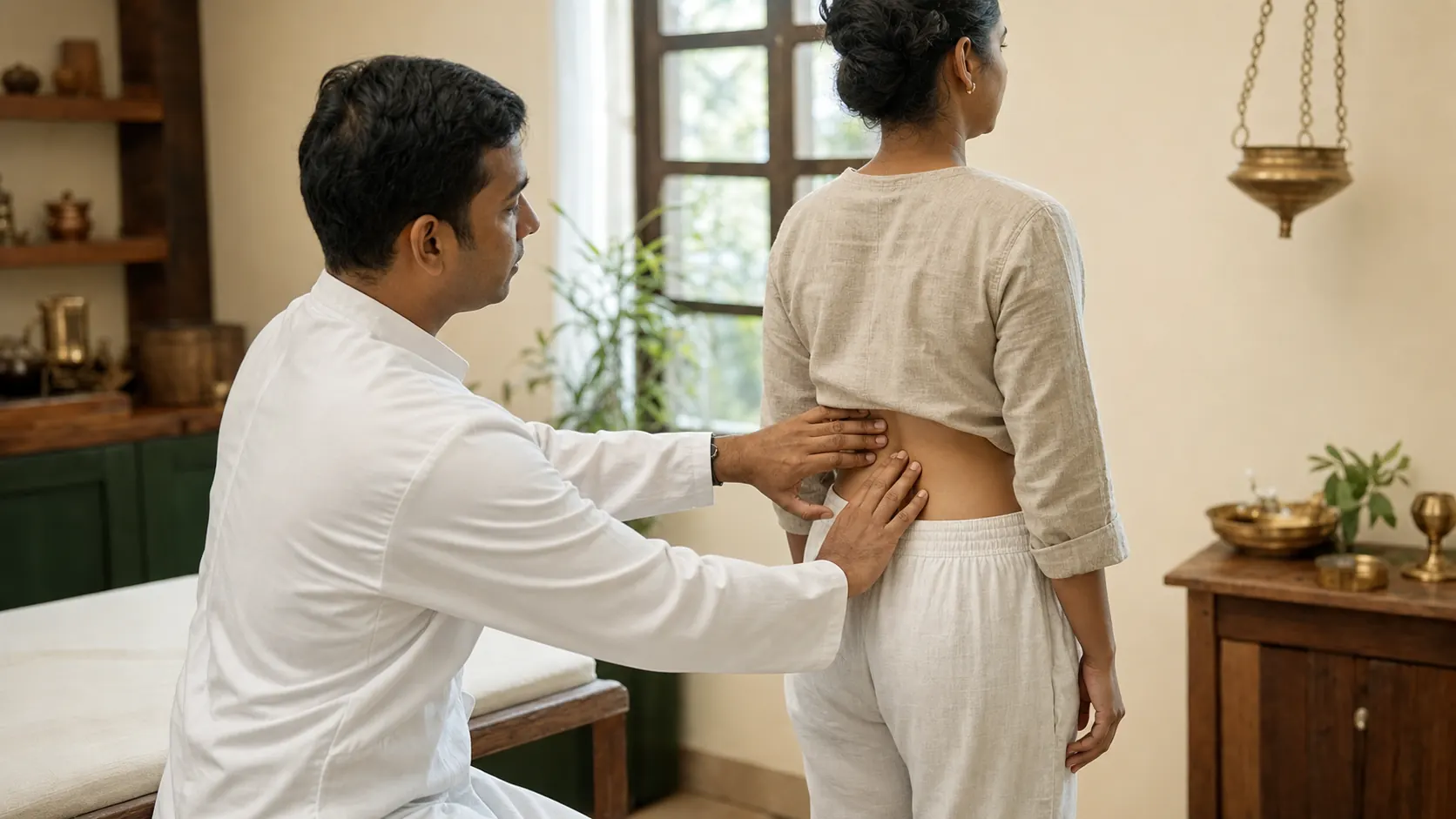
First, the reading
A back is assessed, not booked
Gridhrasi with nerve signs, a strained muscle, an old disc finding and a depleted elderly back are four different prescriptions in the classical system. The physician examines, asks for any scans you have, and sequences accordingly — sometimes gently for days before the intensive work.
Red-flag presentations — trauma, numbness that spreads, loss of control — are hospital medicine first, and an honest physician says so immediately.
How long, and what it costs
Back programmes commonly run 7–14 nights for strain and stiffness pictures, and 14–21 nights where sciatica or long-standing trouble calls for the vasti series and fuller sequence.
Kerala rates, verified July 2026, all-inclusive: 14 nights runs
₹67,000–
What an honest physician will tell you
That imaging findings and symptoms are not the same thing, that the sequence is built for your picture rather than a package, and that prescribed medication is coordinated with, not stopped. Acute red-flag signs belong in a hospital first — a genuine physician screens for exactly that before accepting you.
And no cure promises: honest physicians speak of pain, mobility, sleep and what you can carry — how to tell the honest centres.

What Ayurbook does
The right physician for this, matched to you
We've verified 258 Ayurveda centres across Kerala — the state's classification and NABH's clinical register, both checked. Tell us your situation, dates and budget; we match you to a centre whose physicians actually work with back conditions, with the price in writing before you pay.
Common questions
My back pain is from sitting at a desk — is that treatable this way?
The long-sitting, seized-up back is a textbook vata picture and the bread and butter of Kerala back care — usually the shorter 7–14 night sequence of local oil therapy, boluses and massage, plus the routine corrections the physician sends home with you.
What exactly happens in kati vasti?
You lie face down; a ring of dough is built over the low back and filled with comfortably warm medicated oil, kept warm through the session. It reads as simple — the effect of sustained deep warmth on a guarded back is why it has survived centuries.
I have a disc bulge on my MRI. What will they say?
Bring the report. The physician maps your actual symptoms against it — many disc findings are incidental — and sequences accordingly, starting gently. Nerve red flags (spreading numbness, weakness, loss of control) are referred to hospital care first, and honestly.
Is this just massage?
No — massage (abhyanga) is the preparation layer. The specific work is the local oil-pool therapies, the bolus series, and for deeper cases the physician-set vasti series that the texts rank as the root vata treatment. The full daily rhythm.
How fast will I feel a difference?
Most guests feel the guarding ease within the first days of local therapy — but honest physicians talk about the pattern over weeks, not a single dramatic day, and about what you keep doing after you leave.
What will it cost?
The verified tier structure applies: 7 nights ≈₹33,000–88,000, 14 nights ₹67,000–3.4 lakh all-inclusive by tier. Full breakdown — your exact price in writing before you pay.