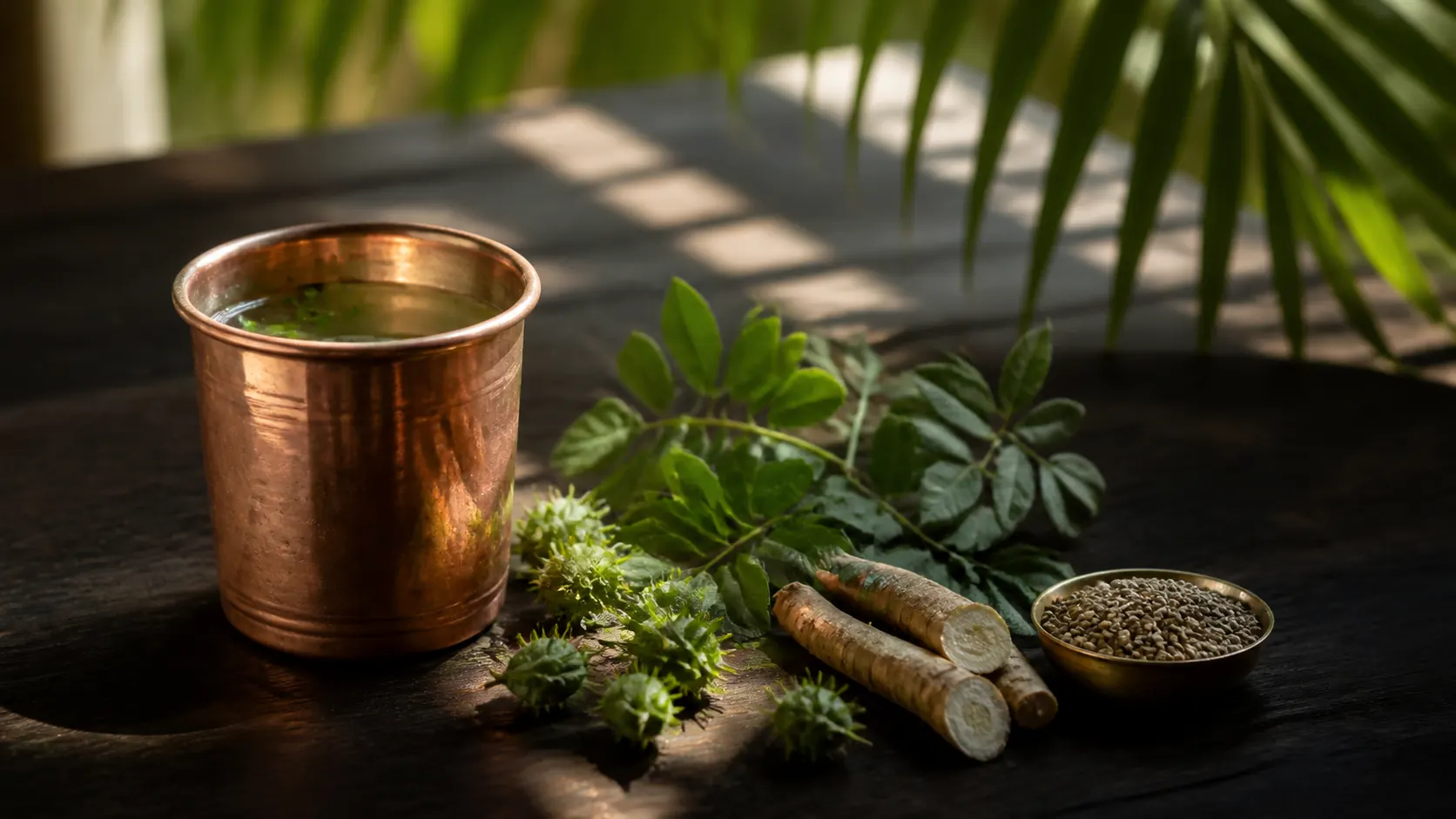
The classical texts treat ashmari (urinary stone) with unusual seriousness — Sushruta counts it among the gravest diseases and devotes chapters to it. The classical medical approach: abundant fluids, a corrected diet, and the dedicated stone pharmacy — varuna (Sushruta's own recommendation), gokshura the diuretic, and pashanabheda, literally “the stone-breaker” — under a physician who also knows when a stone is surgical, as Sushruta himself did.
How classical Ayurveda understands it
Ashmari arises, in the classical reading, when the doshas disturb the urinary channels (mutravaha srotas) and sediment concentrates instead of flowing. Sushruta — the tradition's surgical authority — classifies the stone by dosha, describes its colic exactly, and prescribes both the medical route and, for the stone that will not pass, surgery. That double honesty is two thousand years old.
The medical route is flow: copious fluids, food that keeps urine dilute, and the stone herbs given as decoctions — the same logic the tradition has used continuously since.
The classical toolkit
The classical stone pharmacy is specific and centuries-deep — always physician-dosed.
| Therapy | What it is | Classical role |
|---|---|---|
| Varuna (Crataeva nurvala) | Bark decoctions of the varuna tree | Sushruta's own prescription for ashmari — the tradition's lead stone herb |
| Gokshura (Tribulus terrestris) | The thorny-podded herb, as decoction | Classified mutrala (urine-promoting) and ashmaribhedana (stone-breaking) in the texts |
| Pashanabheda (Bergenia ligulata) | Literally “the stone-breaker” — root preparations | The classical dissolving herb, named for the job |
| Fluid protocol | Warm water and herbal waters through the day | The texts' first prescription: keep the urine flowing and dilute |
| Ahara correction | Diet adjusted to the stone's dosha reading | Classical prevention — the stone that never re-forms |
| Vasti (where vata dominates) | Physician-set enema series | For the vata picture behind recurrent stone formation |
Internal medicines — decoctions, classical formulations — are prescribed by the physician after assessment, never off a menu. Stone formulas (Varunadi kashayam and kin) are classical compounds — the physician doses them to your case.
Know your stone's size? That number decides everything — ask a physician what it means.
Ask what my stone size means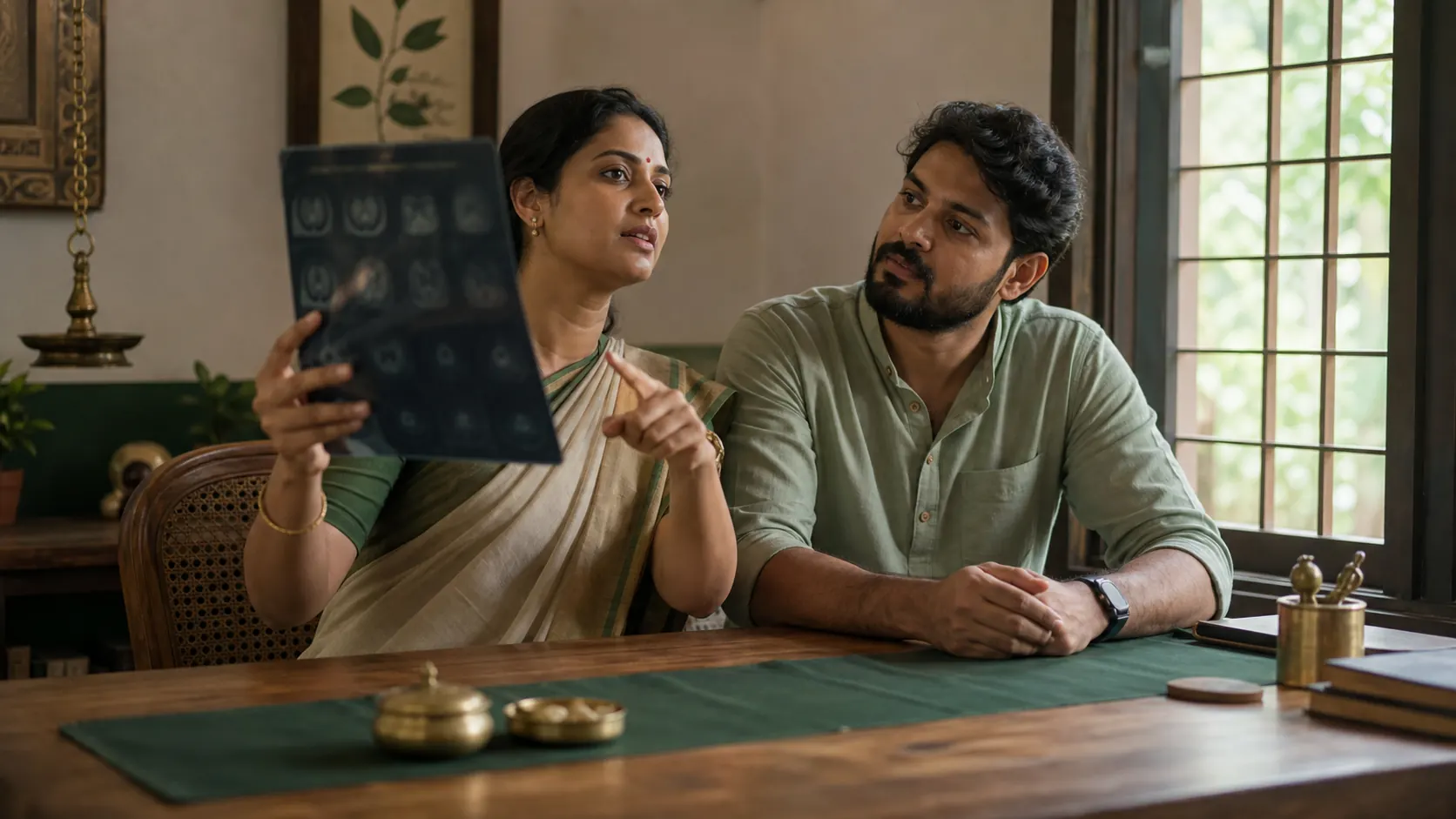
The honest line
Small stones, large stones — different answers
The classical position is the honest one: small stones are medicine's territory — fluids, diet and the stone herbs support their passing and discourage the next one. A large or obstructing stone is surgical territory, and Sushruta said as much in antiquity; a genuine physician sends that case for modern imaging and urology without hesitation.
Where the classical programme shines brightest is the stone that keeps coming back — correcting the pattern that grows them.
How long, and what it costs
Stone care is often outpatient-plus-consult rather than a long residency — decoctions, diet and follow-up. Where a residential programme is prescribed (recurrent stones, a vata picture), 7–14 nights is typical.
Kerala rates, verified July 2026, all-inclusive: 14 nights runs
₹67,000–
What an honest physician will tell you
The size and position of your stone, first — because that decides the route. Colic that will not settle, fever, or blocked flow is emergency medicine, full stop. An honest physician asks for your scan before promising anything, treats the small and the recurring stone, and refers the surgical one — exactly the split the tradition itself drew.

What Ayurbook does
The right physician for this, matched to you
We've verified 258 Ayurveda centres across Kerala — the state's classification and NABH's clinical register, both checked. Tell us your situation, dates and budget; we match you to a centre whose physicians actually work with kidney-stone care, with the price in writing before you pay.
Common questions
I have a small stone (under ~5mm). What does the classical approach offer?
This is the classical sweet spot: a fluid protocol, diet corrected to your reading, and the stone decoctions — varuna, gokshura, pashanabheda — supporting natural passage and discouraging the next stone. Physician-dosed, with your scan on the desk.
My stones keep coming back. Can that pattern be changed?
Recurrence is where the tradition is most useful — the texts read stone formation as a pattern of the urinary channels and treat the pattern: sustained diet correction, fluid habit, and periodic herbal support, with follow-up. This is exactly the long-game medicine Ayurveda is built for.
Will they tell me to skip surgery?
A genuine physician will not — the tradition itself assigns the large, obstructing stone to surgery, and Sushruta was the ancient world's surgical authority. Anyone who tells you to cancel a urologist's plan for a large stone is a warning sign: how to read centres honestly.
Do I need to travel to Kerala for this?
Not always — much stone care works as consultation plus medicines and diet, with follow-up. Ask us first; if a residential programme is prescribed for a recurrent pattern, we match you to the right centre.
What should I have ready before asking?
Your latest scan or report (stone size and position), your symptom history, and your water habit. With those three, a physician can give you a real answer instead of a generic one.
What will it cost?
Consult-led care costs a fraction of a residency; where a 7–14 night programme is prescribed, the verified tier structure applies (7 nights ≈₹33,000–88,000). Full breakdown — and your exact price in writing first.