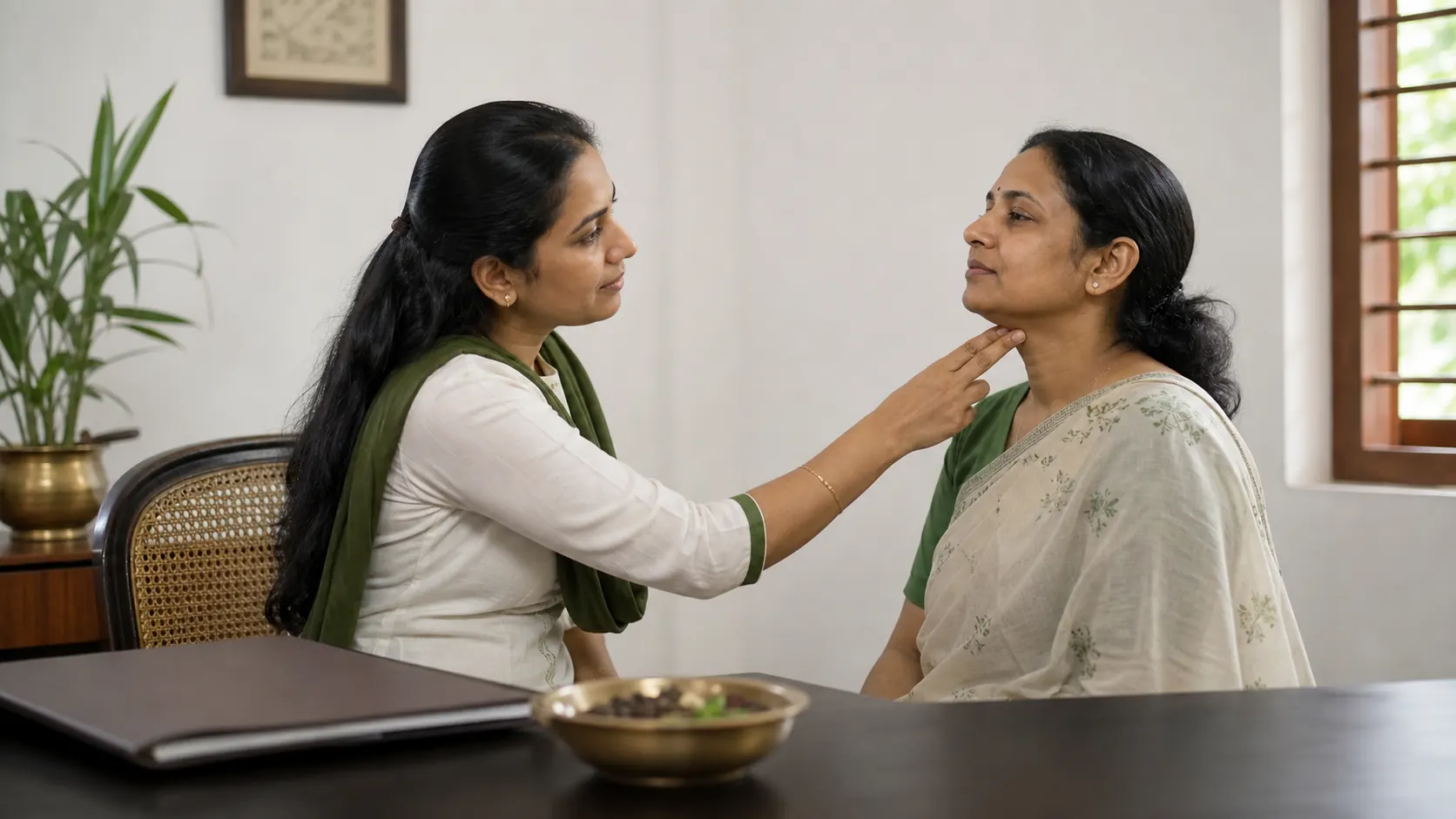
Charaka names the neck swelling galaganda and the texts classify it by dosha — vataja, kaphaja, medoja — reading most thyroid-type pictures through kapha and medas: slowing, heaviness, cold, weight that creeps. The classical response treats that pattern — lightening therapies, virechana where appropriate, rhythm — with the formulary's own instrument, kanchanara guggulu, physician-dosed. Prescribed thyroid medication is never stopped; the physician works alongside it.
How classical Ayurveda understands it
Galaganda appears in Charaka and the later formularies as the swelling at the front of the neck, classified by dosha. The picture most people bring today — sluggishness, weight gain, cold intolerance, thinning hair on a hypothyroid report — reads classically as kapha-medas: the system running heavy and slow.
The classical formularies carry a dedicated answer: kanchanara guggulu — kanchanara bark with guggulu, triphala and warming spices — listed in the galaganda chapters of the classical compendia and still the tradition's first-reach formulation for this territory.
The classical toolkit
Thyroid-territory care in the classical system treats the kapha-medas pattern and uses the formulary's dedicated preparations.
| Therapy | What it is | Classical role |
|---|---|---|
| Kanchanara guggulu | The classical formulation from the galaganda chapters — kanchanara bark, guggulu, triphala, warming spices | The formulary's own instrument for this territory, physician-dosed |
| Udvartana | Brisk upward dry-powder massage | The working therapy for kapha-medas heaviness |
| Virechana | Physician-graded purgation after preparation | Clearing the accumulated pattern where the physician judges it fit |
| Nasya | Herbal administration through the nose | The texts' route to the head and neck region |
| Ahara + dinacharya | Warm light food, fixed rhythm, movement, early sleep | Daily counter-pressure to a system running slow |
| Abhyanga + swedana | Warm oil massage and steam | The steadying base layer of any residential programme |
Internal medicines — decoctions, classical formulations — are prescribed by the physician after assessment, never off a menu. Kanchanara-based formulations are classical compounds from the formularies — dose and fit are the physician's judgement on your reports.
On thyroxine? Good — bring the reports. The physician works alongside it, never against it.
Ask how this fits my treatment
The pattern work
Treating the slowness, not just the gland
What a residential programme actually works on is the lived pattern — the heaviness, the cold mornings, the weight that ignores effort, the fatigue. Food matched to a slow agni, daily udvartana, movement, and rhythm held for weeks: the classical counter-pressure to a system running slow.
Your thyroid numbers stay your endocrinologist's domain; the physician reads them, coordinates, and asks you to re-test on schedule — that division of labour is what honest integration looks like.
How long, and what it costs
Programmes in this territory typically run 14–21 nights, with the food-and-rhythm pattern designed to continue at home and follow-up on your regular bloodwork schedule.
Kerala rates, verified July 2026, all-inclusive: 14 nights runs
₹67,000–
What an honest physician will tell you
Three things, plainly: your prescribed thyroid medication is not stopped — ever — and any centre that suggests it is disqualifying itself. Your diagnosis stays anchored to your bloodwork, re-tested on your doctor's schedule. And the programme's honest target is the pattern — energy, weight behaviour, cold, sluggishness — with the classical formulary in support, not a promised change in your numbers.

What Ayurbook does
The right physician for this, matched to you
We've verified 258 Ayurveda centres across Kerala — the state's classification and NABH's clinical register, both checked. Tell us your situation, dates and budget; we match you to a centre whose physicians actually work with thyroid care, with the price in writing before you pay.
Common questions
My report says hypothyroid and I feel heavy and tired all the time. Is this the right place?
That lived pattern — heaviness, cold, fatigue, stubborn weight — is exactly what the classical kapha-medas reading describes and what a programme works on daily. Bring the report; the physician starts from it.
Is galaganda really the same as my thyroid condition?
Honestly: it is the classical territory, not a one-to-one match. Galaganda described the visible neck swelling; today's lab-diagnosed hypothyroidism is read through the same dosha lens and treated with the same formulary. Genuine physicians are straightforward about that mapping.
What is in kanchanara guggulu and is it safe with my medication?
Kanchanara bark, guggulu resin, triphala and warming spices — a classical compound, not a modern invention. Fit and dose alongside thyroxine are the physician's call on your actual reports, which is why it is prescribed, not bought off a shelf.
Will my TSH change?
Your numbers stay your endocrinologist's domain, re-tested on schedule — no genuine physician promises a lab value. The programme's honest target is how you feel and function day to day.
What happens after the programme?
The food, rhythm and movement pattern is built to travel home with you, with the physician's follow-up and your regular bloodwork continuing. The stay is the reset; the pattern is the medicine.
What will it cost?
The verified tier structure: 14 nights ₹67,000–3.4 lakh all-inclusive by tier. Full breakdown — exact price for your dates in writing before you pay.