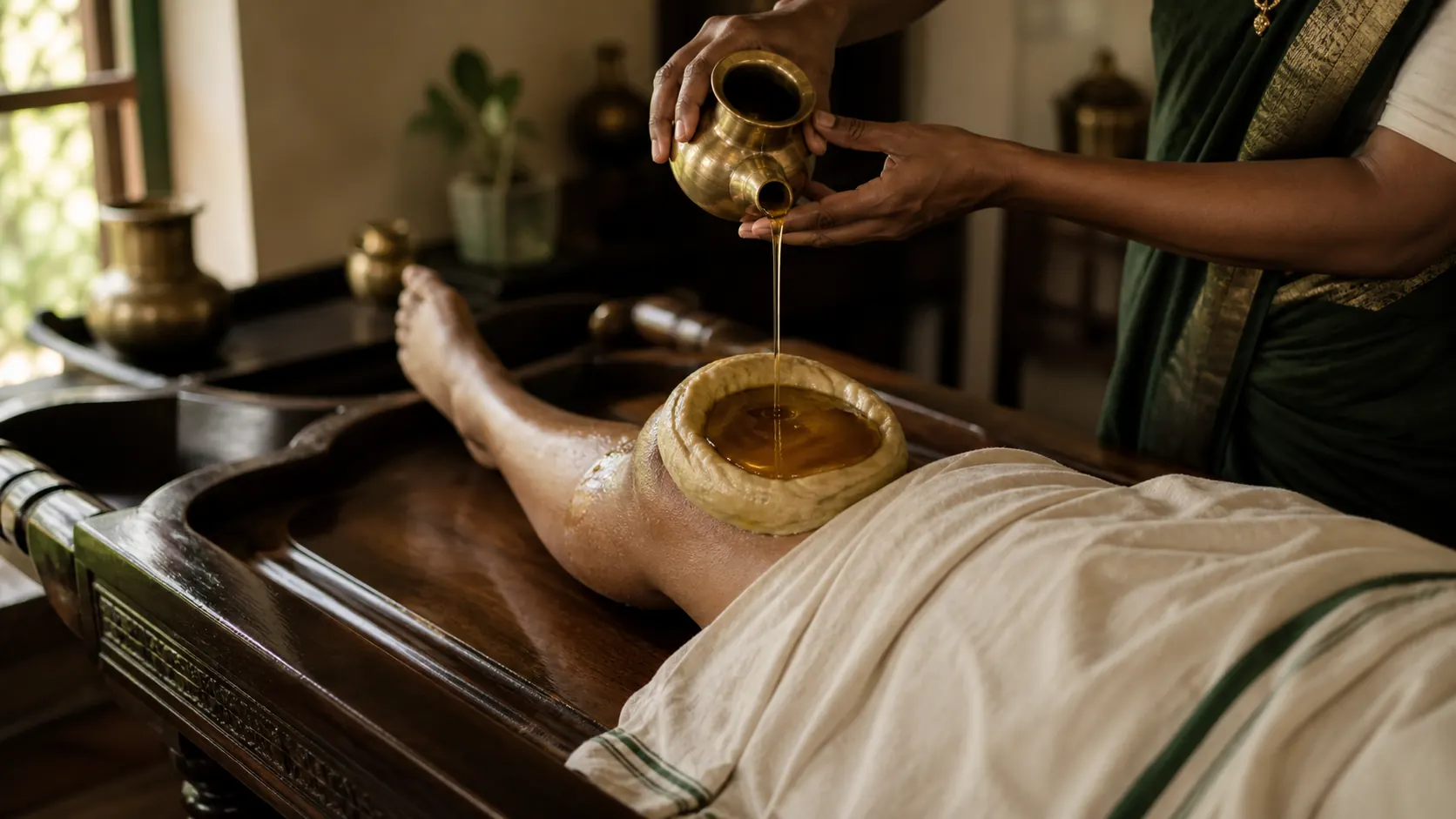
The classical texts describe joint disease precisely: amavata — undigested residue (ama) carried by aggravated vata and lodging in the joints — and sandhigata vata, the dry wear of the joints with age. Kerala's physicians treat both with a sequence the texts prescribe: prepare the tissues with oil and heat, clear what is lodged, then nourish and strengthen — under daily physician review.
How classical Ayurveda understands it
In the Charaka and Ashtanga Hridaya tradition, painful, swollen, stiff joints point to amavata: digestion has left behind a heavy residue, and vata has carried it into the joints, where it lodges. The dry, creaking joint of later life is read differently — sandhigata vata, vata drying the joint's own cushioning.
The distinction matters because the classical responses differ: an ama picture is first lightened and cleared before any oil goes deep; a dry vata picture is oiled and nourished from the start. This is why the physician's assessment comes before the programme — the same swollen knee can need opposite treatments.
The classical toolkit
These are the therapies the classical texts assign to joint disease — the repertoire Kerala centres are best known for worldwide.
| Therapy | What it is | Classical role |
|---|---|---|
| Vasti (medicated enema) | Herbal oils and decoctions administered rectally in a physician-set series | The texts call vasti “half of all treatment” for vata — the root therapy for joint disease |
| Janu / Kati / Greeva vasti | A dough ring on the knee, low back or neck holding a pool of warm medicated oil | Sustained local oleation for a single troubled joint |
| Njavarakizhi | Boluses of medicinal Njavara rice cooked in milk and Bala-root decoction, massaged warm | The nourishing sweda — for weak, worn, degenerative joints |
| Elakizhi / Podikizhi | Heated boluses of fried medicinal leaves or dry powders | The drying sweda — for swollen, inflamed, ama-heavy joints |
| Abhyanga + swedana | Warm dosha-matched oil massage followed by herbal steam | The classical preparation that makes deeper therapy possible |
| Virechana | Physician-graded purgation on its scheduled day | Clearing therapy when the ama picture dominates |
Internal medicines — decoctions, classical formulations — are prescribed by the physician after assessment, never off a menu. For joint disease these classically include Rasnadi and Maharasnadi decoctions and guggulu-based formulations — the physician chooses.
Which of these fits your joints? That's a physician's call — put your case to one online.
Put my case to a physician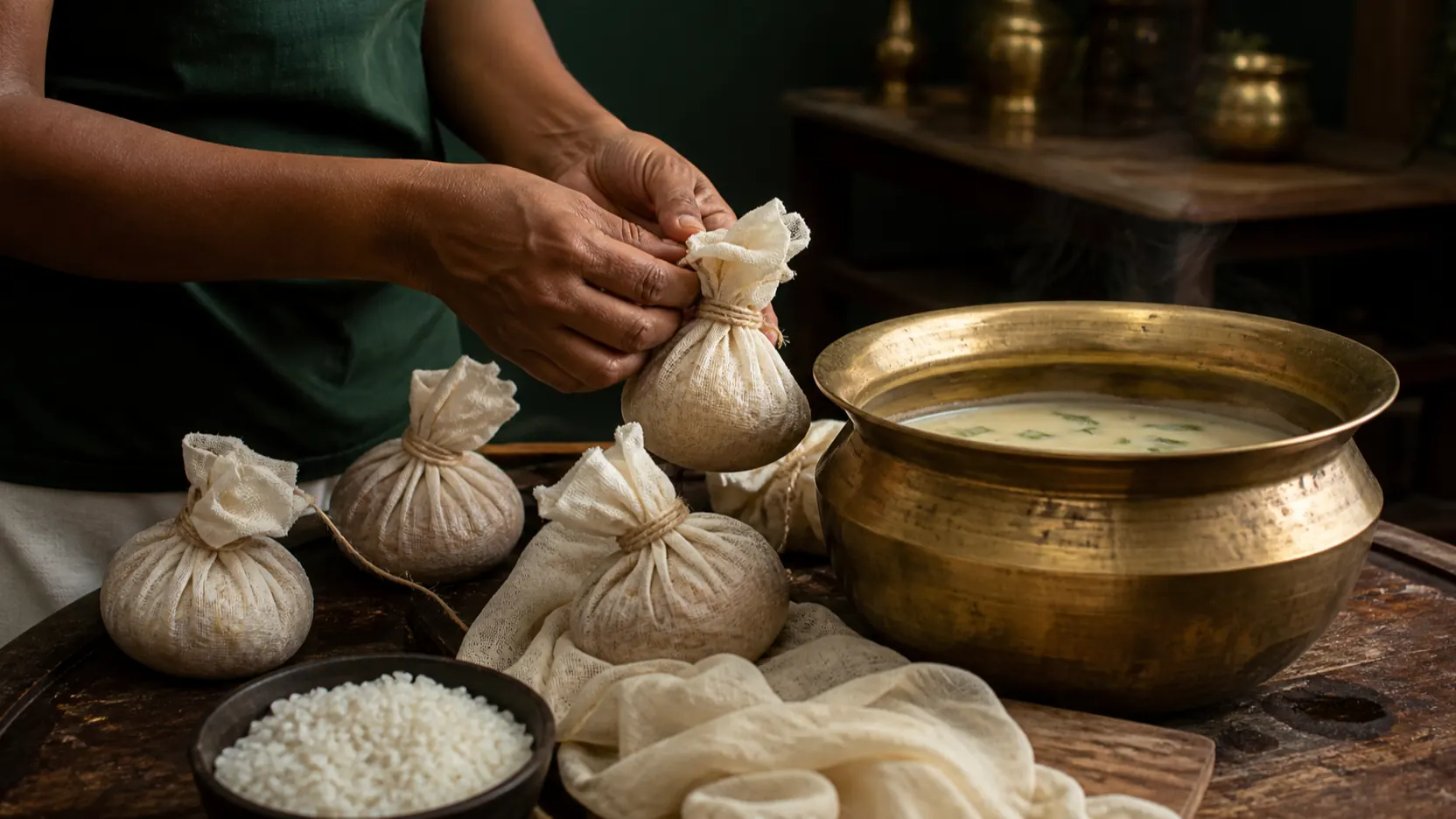
The programme
Weeks, not appointments
Classical joint care is residential by design: daily therapy in sequence, warm prepared food, rest between treatments, and the physician adjusting course each morning. Established programmes for joint conditions run 14–21 nights, with long-standing cases taking the fuller 21–28 night classical course.
The daily rhythm — and why the rest days are part of the treatment — is laid out in what to expect, day by day.
How long, and what it costs
Joint programmes are typically prescribed at 14–21 nights — long enough for preparation, the cleared-and-nourished sequence, and graded recovery. Long-standing or advanced cases are where physicians reach for the complete classical course.
Kerala rates, verified July 2026, all-inclusive: 14 nights runs
₹67,000–
What an honest physician will tell you
That the assessment decides everything — including whether to treat. An ama-dominant flare is handled differently from dry degeneration, and a physician may begin with lighter therapy before any intensive programme. If you take prescribed medication for your joints, it is not stopped; the physician works alongside it.
And no promises of cure — Indian law prohibits advertising cures for arthritis, and a genuine physician talks instead about pain, stiffness, movement and strength, honestly. Centres that promise more are telling you something — here is how to read them.

What Ayurbook does
The right physician for this, matched to you
We've verified 258 Ayurveda centres across Kerala — the state's classification and NABH's clinical register, both checked. Tell us your situation, dates and budget; we match you to a centre whose physicians actually work with joint conditions, with the price in writing before you pay.
Common questions
Is arthritis a condition Ayurveda is actually known for?
Yes — joint disease is among the most precisely described conditions in the classical texts, and the vasti and kizhi therapies Kerala is famous for were developed substantially around it. It is the area where the tradition's repertoire is deepest.
Which therapies would I actually receive?
That is set by the assessment: an inflamed, swollen (ama) picture is lightened and cleared; a dry, worn joint is oiled and nourished. Expect some combination of vasti, local oil-pool therapies, kizhi boluses, abhyanga and steam — sequenced by the physician, adjusted daily.
How many weeks should I plan?
14–21 nights is the usual prescription; longer-standing cases benefit from the complete 21–28 night classical course. Shorter stays deliver genuine relief work but not the full sequence.
Can I do this if I'm elderly?
Age itself is not an exclusion — degenerative joint care is substantially an older person's medicine, and therapies are dosed to capacity. Intensive purification has age limits, but the nourishing joint repertoire does not. The physician decides at screening: see is Panchakarma safe?
Will anyone promise my arthritis will be cured?
Not an honest centre — the law prohibits it and the physicians we work with speak plainly about what changes they aim at: pain, stiffness, range, strength. That honesty is exactly what to look for.
What will it cost?
The same verified tier structure as all Kerala programmes: 14 nights from ₹67,000 (clinical hospital) to ₹3.4 lakh (luxury resort), all-inclusive. Full breakdown here — and we put your exact price in writing before you pay.